
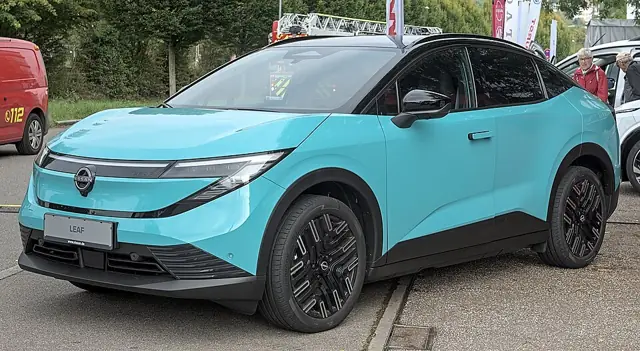
Nissan Leaf
Crossover · 2011–2027

Which year to buy
Too new to judge: 2026. Give a new year a year or two of owner reports.
Bar height: serious owner complaints to NHTSA for that year, against this model's usual year.
2026TOO NEWOnly 1.2 years of owner reports
Only 1.2 years of owner reports so far (2 complaints). 2 recalls.
2 owner complaints · 2 recalls (check a car's VIN for open recalls) · EPA combined: 103–121 mpg · NHTSA: Not rated · 2026 trims and features
2025GOOD BUYSerious complaints 0.4× usual
Few complaints for any year of this model, so the data can't tell this year apart much. 3 serious complaints of 7, the most about speed control (2) and engine (1); 0.4× this model's usual share of all serious complaints about 2025 vehicles.
Fixes and extended coverage
- Repair program On affected vehicles, at temperatures below -10°C/14°F, use of the blower motor at full speed can cause the defrost function to operate at a low electrical current and trigger failsafe logic. Dealers will update the HVAC control software. (NTB24-048, Oct 2024)
From the manufacturer's bulletins filed with NHTSA. A dealer can look up whether a car has had the work done or is still covered.
7 owner complaints · 0 recalls · EPA combined: 109–111 mpg · NHTSA: 5 of 5 stars · 2025 trims and features
2024GOOD BUYSerious complaints 0.1× usual
1 serious complaints of 5, the most about power train (1); 0.1× this model's usual share of all serious complaints about 2024 vehicles.
Fixes and extended coverage
- Repair program On affected vehicles, at temperatures below -10°C/14°F, use of the blower motor at full speed can cause the defrost function to operate at a low electrical current and trigger failsafe logic. Dealers will update the HVAC control software. (NTB24-048, Oct 2024)
From the manufacturer's bulletins filed with NHTSA. A dealer can look up whether a car has had the work done or is still covered.
5 owner complaints · 0 recalls · EPA combined: 109–111 mpg · NHTSA: 5 of 5 stars · 2024 trims and features
2023GOOD BUYSerious complaints 0.7× usual
12 serious complaints of 22, the most about speed control (8) and power train (2); 0.7× this model's usual share of all serious complaints about 2023 vehicles. 3 recalls.
What owners report
“The contact owns a 2023 Nissan Leaf. The contact stated that while driving at low speeds in a parking area, the vehicle suddenly accelerated on its own. As a result, the contact lost control of the vehicle and came to a complete stop after colliding with another vehicle. The air bags did not deploy. No warning lights were illuminated.”
An owner's complaint to NHTSA about the speed control, May 2024
Fixes and extended coverage
- Repair program On affected vehicles, at temperatures below -10°C/14°F, use of the blower motor at full speed can cause the defrost function to operate at a low electrical current and trigger failsafe logic. Dealers will update the HVAC control software. (NTB24-048, Oct 2024)
From the manufacturer's bulletins filed with NHTSA. A dealer can look up whether a car has had the work done or is still covered.
22 owner complaints · 3 recalls (check a car's VIN for open recalls) · EPA combined: 109–111 mpg · NHTSA: 5 of 5 stars · 2023 trims and features
2022CAREFULSerious complaints 2.0× usual, mostly fuel system and power train
40 serious complaints of 96, the most about fuel system (20) and power train (11); 2.0× this model's usual share of all serious complaints about 2022 vehicles. 4 recalls.
What owners report
“My Nissan Leaf 2022 Electric Vehicle(VIN: [] ) is subject to Safety Recall 25V-655 (Manufacturer Recall Number R25C8) dated September 30, 2025. As per the recall notice, the vehicle suffers from 'excessive lithium deposits within battery cells' which can cause 'rapid heating of the battery' and result in a battery fire.”
An owner's complaint to NHTSA about the fuel system, Jan 2026
“Vehicle experienced total electrical propulsion loss while driving on a public highway and had to be towed. Dealer diagnosis confirmed Diagnostic Trouble Code P33ED-00 per Nissan Bulletin NTB26-032. This is related to the open federal battery recall R25C8; the recall remedy failed.”
An owner's complaint to NHTSA about the power train, Oct 2026
Fixes and extended coverage
- Repair program On affected vehicles, at temperatures below -10°C/14°F, use of the blower motor at full speed can cause the defrost function to operate at a low electrical current and trigger failsafe logic. Dealers will update the HVAC control software. (NTB24-048, Oct 2024)
From the manufacturer's bulletins filed with NHTSA. A dealer can look up whether a car has had the work done or is still covered.
96 owner complaints · 4 recalls (check a car's VIN for open recalls) · EPA combined: 104–111 mpg · NHTSA: 5 of 5 stars · 2022 trims and features
2021GOOD BUYSerious complaints 1.0× usual
22 serious complaints of 57, the most about fuel system (10) and engine (6); 1.0× this model's usual share of all serious complaints about 2021 vehicles. 4 recalls.
What owners report
“Incident Summary & Ineffective Recall Remedy: I am reporting an acute high-voltage battery cell collapse on my 2021 Nissan LEAF (VIN: []). The vehicle previously received the software update for NHTSA Recall #25V655 (Nissan Recall #R25C8) at Kings Nissan. The software patch failed to repair the underlying defective battery hardware.”
An owner's complaint to NHTSA about the fuel system, Sep 2026
“The contact owned a 2021 Nissan Leaf. The contact received notification of NHTSA Campaign Number: 25V655000 (Electrical System). The contact stated that while at a dealer charging the vehicle for approximately 15- 20 minutes, there was a fire coming from the front of the vehicle.”
An owner's complaint to NHTSA about the engine, Aug 2026
Fixes and extended coverage
- Repair program On affected vehicles, at temperatures below -10°C/14°F, use of the blower motor at full speed can cause the defrost function to operate at a low electrical current and trigger failsafe logic. Dealers will update the HVAC control software. (NTB24-048, Oct 2024)
From the manufacturer's bulletins filed with NHTSA. A dealer can look up whether a car has had the work done or is still covered.
57 owner complaints · 4 recalls (check a car's VIN for open recalls) · EPA combined: 104–111 mpg · NHTSA: 5 of 5 stars · 2021 trims and features
2020AVOIDSerious complaints 2.6× usual, mostly fuel system and power train
60 serious complaints of 167, the most about fuel system (35) and power train (14); 2.6× this model's usual share of all serious complaints about 2020 vehicles. 6 recalls.
What owners report
“I own a 2020 Nissan Leaf affected by recall 24V-700 (Nissan R24B2). The recall opened in September 2024 because the high-voltage battery can overheat and catch fire during Level 3 fast charging. Owners were told not to use fast charging until a remedy is available.”
An owner's complaint to NHTSA about the fuel system, Jun 2026
“Regarding Nissan Safety Recall 24V-700 / Campaign R24B2. After the recall remedy was performed on my 2020 LEAF in June I experienced the "Service EV System" message during normal highway driving on 8/1/26. I have an invoice from the dealership that documented logged safety recall code P33ED along with EV system codes P317E-97 and P3180-97.”
An owner's complaint to NHTSA about the power train, Aug 2026
Fixes and extended coverage
- Repair program On affected vehicles, at temperatures below -10°C/14°F, use of the blower motor at full speed can cause the defrost function to operate at a low electrical current and trigger failsafe logic. Dealers will update the HVAC control software. (NTB24-048, Oct 2024)
From the manufacturer's bulletins filed with NHTSA. A dealer can look up whether a car has had the work done or is still covered.
167 owner complaints · 6 recalls (check a car's VIN for open recalls) · EPA combined: 104–111 mpg · NHTSA: 5 of 5 stars · 2020 trims and features
2019CAREFULSerious complaints 2.0× usual, mostly fuel system and power train
67 serious complaints of 260, the most about fuel system (34) and power train (13); 2.0× this model's usual share of all serious complaints about 2019 vehicles. 5 recalls.
What owners report
“NHTSA Recall Number24V-700 It has been over 1yr since the recall was issued for fire risk on the Nissan leaf and still no fix is available. Nissan continues to ask users to not charge with level 3 charging which in my leaf was an expensive option. Limits my ability to use my car for longer trips.”
An owner's complaint to NHTSA about the fuel system, Oct 2025
“Manufacturer Name : Nissan North America, Inc. Submission Date : SEP 19, 2024 NHTSA Recall No. : 24V-700 Manufacturer Recall No. : R24B2 My Vehicle: 2019 Nissan LEAF Description of the Safety Risk: While the vehicle is Level 3 quick charging, the increased electrical resistance could result in rapid heating of the battery.”
An owner's complaint to NHTSA about the power train, Mar 2026
Fixes and extended coverage
- Repair program Due to a manufacturing assembly issue, that has since been corrected, the radiator may have been damaged during vehicle assembly. Nissan will be conducting a voluntary service campaign in North America on certain MY 2019 Nissan LEAF vehicles to replace the radiator and bolt. (PC723, Jan 2020)
- Repair program Nissan is conducting this voluntary service campaign on certain specific model year 2019 LEAF vehicles. This service will be performed at no charge to the customer for parts or labor. (NTB20-003, Jan 2020)
- Repair program The plates may corrode and in areas where road salt is extensively used, could break. Nissan will be conducting a voluntary service campaign in North America on certain MY 2011-19 Nissan LEAF vehicles to replace the Lithium-ion Battery Bonding Plates. (P9312, Jul 2019)
- Repair program On affected vehicles, at temperatures below -10°C/14°F, use of the blower motor at full speed can cause the defrost function to operate at a low electrical current and trigger failsafe logic. Dealers will update the HVAC control software. (NTB24-048, Oct 2024)
- Repair program INTRODUCTION Nissan is conducting this voluntary service campaign on certain specific model year 2011-2019 LEAF vehicles to replace the Lithium-Ion battery bonding plates. This service will be performed at no charge to the customer for parts or labor. (NTB19-055, Jul 2019)
- Repair program Nissan is conducting this voluntary service campaign on certain specific model year 2019 LEAF vehicles to replace the power delivery module (PDM). This service will be performed at no charge to the customer for parts or labor. (NTB19-119, Dec 2019)
From the manufacturer's bulletins filed with NHTSA. A dealer can look up whether a car has had the work done or is still covered.
260 owner complaints · 5 recalls (check a car's VIN for open recalls) · EPA combined: 104–112 mpg · NHTSA: Not rated · 2019 trims and features
2018GOOD BUYSerious complaints 1.3× usual, mostly brakes and fuel system
First year with Apple CarPlay. 53 serious complaints of 67, the most about brakes (19) and fuel system (13); 1.3× this model's usual share of all serious complaints about 2018 vehicles. 4 recalls.
What owners report
“I was stopped at a light, in a long line of cars, my foot on the brake, a few feet away from the car in front of me, and the same in back. All of a sudden, the car started moving, accelerating, jerking forward.”
An owner's complaint to NHTSA about the brakes, Jun 2023
“I was traveling north on Freeway 57 at approximately 70mph. The dash lit up red with 12v and charging warnings. Power was shut off and car went into Neutral and warned me to pull over. This is an incredibly busy freeway and I was in the far left lane.”
An owner's complaint to NHTSA about the fuel system, Dec 2025
When problems show up
Half of the 18 serious complaints that gave a mileage came before 7,300 miles.
From owner complaints to NHTSA that gave a mileage.
Fixes and extended coverage
- Repair program The plates may corrode and in areas where road salt is extensively used, could break. Nissan will be conducting a voluntary service campaign in North America on certain MY 2011-19 Nissan LEAF vehicles to replace the Lithium-ion Battery Bonding Plates. (P9312, Jul 2019)
- Repair program On affected vehicles, at temperatures below -10°C/14°F, use of the blower motor at full speed can cause the defrost function to operate at a low electrical current and trigger failsafe logic. Dealers will update the HVAC control software. (NTB24-048, Oct 2024)
- Repair program INTRODUCTION Nissan is conducting this voluntary service campaign on certain specific model year 2011-2019 LEAF vehicles to replace the Lithium-Ion battery bonding plates. This service will be performed at no charge to the customer for parts or labor. (NTB19-055, Jul 2019)
From the manufacturer's bulletins filed with NHTSA. A dealer can look up whether a car has had the work done or is still covered.
67 owner complaints · 4 recalls (check a car's VIN for open recalls) · EPA combined: 112 mpg · NHTSA: Not rated · 2018 trims and features
2017BEST BUYSerious complaints 0.3× usual
14 serious complaints of 17, the most about air bags (4) and fuel system (3); 0.3× this model's usual share of all serious complaints about 2017 vehicles. 2 recalls.
What owners report
“Airbag light flashing. Airbag might not deploy in event of accident. Nissan service stated "code B00A0 triggered in SRS control unit. Failure within OCS circuit. Recommends replacement of OCS SENSORS and Control Unit." Stated my VIN is not included in all the other OCS recalls.”
An owner's complaint to NHTSA about the air bags, Apr 2024
“Hello! I have my 2017 nissan leaf sv with 30kwh battery in at nissan of troy, mainly due to two problems. This is a 2017 nissan leaf with 30kwh batte hello! I have my 2017 nissan leaf sv with 30kwh battery in at nissan of troy, mainly due to two problems.”
An owner's complaint to NHTSA about the fuel system, Jan 2021
Fixes and extended coverage
- Repair program Nissan data gathering has shown the vehicle's driving range gauge and Lithium-ion battery capacity level gauge may indicate a range/capacity that is lower than the actual amount due to a design issue associated with an improper capacity calculation. Nissan is conducting a Voluntary Service… (PC630, Jun 2018)
- Repair program The plates may corrode and in areas where road salt is extensively used, could break. Nissan will be conducting a voluntary service campaign in North America on certain MY 2011-19 Nissan LEAF vehicles to replace the Lithium-ion Battery Bonding Plates. (P9312, Jul 2019)
- Repair program Nissan is conducting this voluntary service campaign on certain specific model year 2016-2017 LEAF vehicles to reprogram the Lithium-Ion Battery Controller (LBC). This service will be performed at no charge to the customer for parts or labor. (NTB18-039, Jun 2018)
- Repair program INTRODUCTION Nissan is conducting this voluntary service campaign on certain specific model year 2011-2019 LEAF vehicles to replace the Lithium-Ion battery bonding plates. This service will be performed at no charge to the customer for parts or labor. (NTB19-055, Jul 2019)
From the manufacturer's bulletins filed with NHTSA. A dealer can look up whether a car has had the work done or is still covered.
17 owner complaints · 2 recalls (check a car's VIN for open recalls) · EPA combined: 112 mpg · NHTSA: Not rated · 2017 trims and features
2016GOOD BUYSerious complaints 0.7× usual
32 serious complaints of 36, the most about brakes (16) and fuel system (8); 0.7× this model's usual share of all serious complaints about 2016 vehicles. 4 recalls.
What owners report
“This has happened to me intermittently at first ... Now permanently and cannot be diagnosed by nissan.”
An owner's complaint to NHTSA about the brakes, Jul 2026
“While climbing the incline section of the San Mateo Bridge in the fast lane, the Leaf shifted itself into Neutral and would not shift back into Drive. With no power, driver was forced to change lanes to the right with no power, but luckily made it over the top and down the decline to pull over. Vehicle did not want to shut off or shift.”
An owner's complaint to NHTSA about the fuel system, Mar 2024
When problems show up
Half of the 16 serious complaints that gave a mileage came before 17,000 miles.
Brakes (11 serious complaints): half came before 20,000 miles; 82% within a typical 36,000-mile new-car warranty.
From owner complaints to NHTSA that gave a mileage.
Fixes and extended coverage
- Repair program Nissan data gathering has shown the vehicle's driving range gauge and Lithium-ion battery capacity level gauge may indicate a range/capacity that is lower than the actual amount due to a design issue associated with an improper capacity calculation. Nissan is conducting a Voluntary Service… (PC630, Jun 2018)
- Repair program The plates may corrode and in areas where road salt is extensively used, could break. Nissan will be conducting a voluntary service campaign in North America on certain MY 2011-19 Nissan LEAF vehicles to replace the Lithium-ion Battery Bonding Plates. (P9312, Jul 2019)
- Repair program Nissan is conducting this voluntary service campaign on certain specific model year 2016-2017 LEAF vehicles to reprogram the Lithium-Ion Battery Controller (LBC). This service will be performed at no charge to the customer for parts or labor. (NTB18-039, Jun 2018)
- Repair program INTRODUCTION Nissan is conducting this voluntary service campaign on certain specific model year 2011-2019 LEAF vehicles to replace the Lithium-Ion battery bonding plates. This service will be performed at no charge to the customer for parts or labor. (NTB19-055, Jul 2019)
From the manufacturer's bulletins filed with NHTSA. A dealer can look up whether a car has had the work done or is still covered.
36 owner complaints · 4 recalls (check a car's VIN for open recalls) · EPA combined: 112–114 mpg · NHTSA: 4 of 5 stars · 2016 trims and features
2015CAREFULSerious complaints 2.3× usual, mostly brakes and speed control
100 serious complaints of 110, the most about brakes (84) and speed control (8); 2.3× this model's usual share of all serious complaints about 2015 vehicles. 4 recalls.
What owners report
“Primary brakes malfunction while coming to a stop on city street. Brake warning dash light illuminated. Brake peddle depressed to floor with very diminished effect. Loud clicking nose coming from under hood when brake peddle is depressed. Emergency brake required to hold car stopped when shifting into forward or reverse.”
An owner's complaint to NHTSA about the brakes, Jan 2021
“The contact owns a 2015 nissan leaf. While merging onto a highway at 55 mph, the accelerator pedal became stuck which resulted in unintended acceleration. The contact was able to regain control by depressing the brake pedal. Prior to the failure, the vehicle experienced the same failure without warning.”
An owner's complaint to NHTSA about the speed control, Oct 2015
When problems show up
Half of the 64 serious complaints that gave a mileage came before 29,500 miles.
Brakes (52 serious complaints): half came before 32,300 miles; 63% within a typical 36,000-mile new-car warranty.
From owner complaints to NHTSA that gave a mileage.
Fixes and extended coverage
- Repair program Nissan is conducting a Voluntary Service Campaign on Certain 2013-2015 LEAF vehicles to reprogram the Electrically-driven Intelligent Brake Control Unit. (P5327, Oct 2015)
- Repair program The plates may corrode and in areas where road salt is extensively used, could break. Nissan will be conducting a voluntary service campaign in North America on certain MY 2011-19 Nissan LEAF vehicles to replace the Lithium-ion Battery Bonding Plates. (P9312, Jul 2019)
- Repair program Nissan is conducting this voluntary service campaign on certain specific 2013 2015 LEAF vehicles to replace the high pressure pipe and the high pressure flexible hose for the AC system. This service will be performed at no charge for parts or labor. (NTB16050, May 2016)
- Repair program Nissan is conducting a Voluntary Service Campaign (in the U.S. DEALER RESPONSIBILITY Dealers are to repair vehicles falling within range of this campaign that enter the service department. (NTB17-077, Jul 2017)
- Repair program Nissan is conducting a Voluntary Service Campaign on certain specific 2011-2015 LEAF vehicles to disable (turn off) the 2G Telematics Control Unit (“2G TCU”). (P7332, Jul 2017)
- Repair program INTRODUCTION Nissan is conducting this voluntary service campaign on certain specific model year 2011-2019 LEAF vehicles to replace the Lithium-Ion battery bonding plates. This service will be performed at no charge to the customer for parts or labor. (NTB19-055, Jul 2019)
From the manufacturer's bulletins filed with NHTSA. A dealer can look up whether a car has had the work done or is still covered.
110 owner complaints · 4 recalls (check a car's VIN for open recalls) · EPA combined: 114 mpg · NHTSA: 4 of 5 stars · 2015 trims and features
2014GOOD BUYSerious complaints 0.6× usual
30 serious complaints of 34, the most about brakes (18) and air bags (4); 0.6× this model's usual share of all serious complaints about 2014 vehicles. 6 recalls. NHTSA investigation EA15004: occupant classification system failure. NHTSA investigation RQ15001: occupant classification system failure.
What owners report
“The contact owns a 2014 Nissan Leaf. The contact stated that while his wife was reversing from the garage, the brake pedal was depressed; however, the vehicle failed to stop immediately. Additionally, several unknown warning lights were illuminated. The vehicle was not diagnosed nor repaired by an independent mechanic or dealer.”
An owner's complaint to NHTSA about the brakes, Apr 2023
“There is an air bag light that illuminates when there is weight on the passenger seat but the air bag will not be deployed, maybe because the vehicle thinks there is a dog, small child, or inanimate object sitting in the seat.”
An owner's complaint to NHTSA about the air bags, Jun 2015
When problems show up
Half of the 24 serious complaints that gave a mileage came before 21,300 miles.
Brakes (15 serious complaints): half came before 41,000 miles; 47% within a typical 36,000-mile new-car warranty.
From owner complaints to NHTSA that gave a mileage.
Fixes and extended coverage
- Repair program Nissan is conducting a Voluntary Service Campaign on Certain 2013-2015 LEAF vehicles to reprogram the Electrically-driven Intelligent Brake Control Unit. (P5327OL, Nov 2015)
- Repair program The plates may corrode and in areas where road salt is extensively used, could break. Nissan will be conducting a voluntary service campaign in North America on certain MY 2011-19 Nissan LEAF vehicles to replace the Lithium-ion Battery Bonding Plates. (P9312, Jul 2019)
- Repair program Nissan is conducting this voluntary service campaign on certain specific 2013 2015 LEAF vehicles to replace the high pressure pipe and the high pressure flexible hose for the AC system. This service will be performed at no charge for parts or labor. (NTB16050, May 2016)
- Repair program Nissan is conducting a Voluntary Service Campaign (in the U.S. DEALER RESPONSIBILITY Dealers are to repair vehicles falling within range of this campaign that enter the service department. (NTB17-077, Jul 2017)
- Repair program Nissan is conducting a Voluntary Service Campaign on certain specific 2011-2015 LEAF vehicles to disable (turn off) the 2G Telematics Control Unit (“2G TCU”). (P7332, Jul 2017)
- Repair program INTRODUCTION Nissan is conducting this voluntary service campaign on certain specific model year 2011-2019 LEAF vehicles to replace the Lithium-Ion battery bonding plates. This service will be performed at no charge to the customer for parts or labor. (NTB19-055, Jul 2019)
From the manufacturer's bulletins filed with NHTSA. A dealer can look up whether a car has had the work done or is still covered.
34 owner complaints · 6 recalls (check a car's VIN for open recalls) · EPA combined: 114 mpg · NHTSA: 4 of 5 stars · 2014 trims and features
2013GOOD BUYSerious complaints 1.2× usual
63 serious complaints of 81, the most about brakes (32) and air bags (17); 1.2× this model's usual share of all serious complaints about 2013 vehicles. 5 recalls. NHTSA investigation EA15004: occupant classification system failure. NHTSA investigation RQ15001: occupant classification system failure.
What owners report
“The contact owns a 2013 nissan leaf. While driving 50 mph, the vehicle failed to stop when the brake pedal was depressed. As a result, the contact crashed into the preceding vehicle. The front driver's air bag deployed. The vehicle was towed to an independent facility. A police report was filed. There were no injuries.”
An owner's complaint to NHTSA about the brakes, Nov 2017
“SRS Airbag light has been flashing for about a year. Code reader shows B00A0 0009 code indicating a problem with the OCS / Occupancy sensor. I believe this puts all passengers in the front seat at risk since the airbag may not operate in an accident. The car is available for inspection.”
An owner's complaint to NHTSA about the air bags, Apr 2023
When problems show up
Half of the 46 serious complaints that gave a mileage came before 25,000 miles.
Brakes (28 serious complaints): half came before 36,000 miles; 46% within a typical 36,000-mile new-car warranty.
From owner complaints to NHTSA that gave a mileage.
Fixes and extended coverage
- Repair program Nissan is conducting a voluntary service campaign on certain Model Year 2013 LEAF vehicles to reprogram the Power Delivery Module (PDM). This service will be performed at no charge for parts or labor. (NTB13098, Nov 2013)
- Repair program Nissan is conducting a Voluntary Service Campaign on Certain 2013-2015 LEAF vehicles to reprogram the Electrically-driven Intelligent Brake Control Unit. (P5327OL, Nov 2015)
- Repair program The plates may corrode and in areas where road salt is extensively used, could break. Nissan will be conducting a voluntary service campaign in North America on certain MY 2011-19 Nissan LEAF vehicles to replace the Lithium-ion Battery Bonding Plates. (P9312, Jul 2019)
- Repair program Nissan is conducting this voluntary service campaign on certain specific 2013 2015 LEAF vehicles to replace the high pressure pipe and the high pressure flexible hose for the AC system. This service will be performed at no charge for parts or labor. (NTB16050, May 2016)
- Repair program Nissan is conducting a Voluntary Service Campaign (in the U.S. DEALER RESPONSIBILITY Dealers are to repair vehicles falling within range of this campaign that enter the service department. (NTB17-077, Jul 2017)
- Repair program Nissan is conducting a Voluntary Service Campaign on certain specific 2011-2015 LEAF vehicles to disable (turn off) the 2G Telematics Control Unit (“2G TCU”). (P7332, Jul 2017)
From the manufacturer's bulletins filed with NHTSA. A dealer can look up whether a car has had the work done or is still covered.
81 owner complaints · 5 recalls (check a car's VIN for open recalls) · EPA combined: 115 mpg · NHTSA: 4 of 5 stars · 2013 trims and features
2012GOOD BUYSerious complaints 0.8× usual
39 serious complaints of 57, the most about brakes (22) and air bags (11); 0.8× this model's usual share of all serious complaints about 2012 vehicles. NHTSA investigation PE19015: front occupant classification system mat.
What owners report
“Brakes grab and lurch the car to a stop. This occurs especially at low speeds in stop-and-go traffic and thus is dangerous. A driver following close behind will be surprised by the very rapid deceleration. It happens often, always at speeds below about 10 - 15 mph, but not every time I brake, and it is unpredictable.”
An owner's complaint to NHTSA about the brakes, Nov 2018
“Passenger seat occupancy sensor (ocs) has failed. Only repair offered by nissan is to replace the entire cushion seat assembly, which includes a side airbag and seat heater, for over $4000 - this is approximately the value of the car on the used market! A similar failure for later model years (2013-2016) resulted in a mandatory recall.”
An owner's complaint to NHTSA about the air bags, Apr 2019
When problems show up
Half of the 28 serious complaints that gave a mileage came before 19,700 miles.
Brakes (19 serious complaints): half came before 19,400 miles; 79% within a typical 36,000-mile new-car warranty.
From owner complaints to NHTSA that gave a mileage.
Fixes and extended coverage
- Repair program Discard all previous versions of NTB12-007. (NTB12-007, Sep 2021)
- Repair program The plates may corrode and in areas where road salt is extensively used, could break. Nissan will be conducting a voluntary service campaign in North America on certain MY 2011-19 Nissan LEAF vehicles to replace the Lithium-ion Battery Bonding Plates. (P9312, Jul 2019)
- Repair program Nissan is conducting a Voluntary Service Campaign which is providing a new software enhancement for model year 2011-2012 LEAF vehicles, updating them with the software currently used in production for 2013 model year LEAF vehicles. (P3227, Jun 2013)
- Repair program This voluntary service campaign provides complimentary update of certain vehicle software in MY11-12 LEAFs to match current MY13 production specifications. (NTB13061, Jun 2013)
- Repair program Nissan is conducting a Voluntary Service Campaign (in the U.S. DEALER RESPONSIBILITY Dealers are to repair vehicles falling within range of this campaign that enter the service department. (NTB17-077, Jul 2017)
- Repair program Nissan is conducting a Voluntary Service Campaign on certain specific 2011-2015 LEAF vehicles to disable (turn off) the 2G Telematics Control Unit (“2G TCU”). (P7332, Jul 2017)
From the manufacturer's bulletins filed with NHTSA. A dealer can look up whether a car has had the work done or is still covered.
57 owner complaints · 0 recalls · EPA combined: 99 mpg · NHTSA: 5 of 5 stars · 2012 trims and features
2011CAREFULSerious complaints 1.6× usual, mostly air bags and brakes
74 serious complaints of 95, the most about air bags (35) and brakes (16); 1.6× this model's usual share of all serious complaints about 2011 vehicles. NHTSA investigation PE19015: front occupant classification system mat.
What owners report
“Airbag light flashing. Passenger air bags are disabled. Dealer fix is a need a new passenger seat at a cost of $3,000+. Current fault code is b1018. Occupant sensor unit fail. No damage to seat or cushion. It just stopped working. Safety issue. Safety recall should be implemented.”
An owner's complaint to NHTSA about the air bags, Jul 2020
“The brakes malfunction at low speeds, but are not included in a recall program. Nissan has not helped and does not respond to emails or questions on twitter. At low speeds the brakes will sporadically engage and disengage with regenerative braking enabled.”
An owner's complaint to NHTSA about the brakes, Jan 2020
When problems show up
Half of the 55 serious complaints that gave a mileage came before 35,900 miles.
Air bags (20 serious complaints): half came before 59,100 miles; 5% within a typical 36,000-mile new-car warranty.
Brakes (15 serious complaints): half came before 25,000 miles; 80% within a typical 36,000-mile new-car warranty.
From owner complaints to NHTSA that gave a mileage.
Fixes and extended coverage
- Repair program Discard all previous versions of NTB12-007. (NTB12-007, Sep 2021)
- Repair program The plates may corrode and in areas where road salt is extensively used, could break. Nissan will be conducting a voluntary service campaign in North America on certain MY 2011-19 Nissan LEAF vehicles to replace the Lithium-ion Battery Bonding Plates. (P9312, Jul 2019)
- Repair program Nissan is conducting a Voluntary Service Campaign which is providing a new software enhancement for model year 2011-2012 LEAF vehicles, updating them with the software currently used in production for 2013 model year LEAF vehicles. (P3227, Jun 2013)
- Repair program This voluntary service campaign provides complimentary update of certain vehicle software in MY11-12 LEAFs to match current MY13 production specifications. (NTB13061, Jun 2013)
- Repair program Nissan is conducting a Voluntary Service Campaign (in the U.S. DEALER RESPONSIBILITY Dealers are to repair vehicles falling within range of this campaign that enter the service department. (NTB17-077, Jul 2017)
- Repair program Nissan is conducting a Voluntary Service Campaign on certain specific 2011-2015 LEAF vehicles to disable (turn off) the 2G Telematics Control Unit (“2G TCU”). (P7332, Jul 2017)
From the manufacturer's bulletins filed with NHTSA. A dealer can look up whether a car has had the work done or is still covered.
95 owner complaints · 0 recalls · EPA combined: 99 mpg · NHTSA: 5 of 5 stars · 2011 trims and features
Verdicts computed from NHTSA owner complaints, defect investigations and recalls. NHTSA doesn't publish sales, so only big differences count. (How we judge.) Data checked 2026-10-24.
Year by year
| Year | Engines | Drive | Fuel economy | Crash rating | Recalls | Owner complaints | Most-reported problem | CarPlay | Asking price (used) |
|---|---|---|---|---|---|---|---|---|---|
| 2027 | — | — | — | Not rated | 0 | 0 | — | — | — |
| 2026 | Electric | FWD | 103–121 MPGe | Not rated | 2 | 2 | Electrical system (2) | — | — |
| 2025 | Electric | FWD | 109–111 MPGe | 5 of 5 | 0 | 7 | Electrical system (3) | Yes | $16,900 16,000 mi |
| 2024 | Electric | FWD | 109–111 MPGe | 5 of 5 | 0 | 5 | Unknown or other (4) | Yes | $18,900 18,000 mi |
| 2023 | Electric | FWD | 109–111 MPGe | 5 of 5 | 3 | 22 | Vehicle speed control (8) | Yes | $16,600 29,000 mi |
| 2022 | Electric | FWD | 104–111 MPGe | 5 of 5 | 4 | 96 | Electrical system (62) | Yes | $14,100 47,000 mi |
| 2021 | Electric | FWD | 104–111 MPGe | 5 of 5 | 4 | 57 | Electrical system (32) | Yes | $14,700 35,000 mi |
| 2020 | Electric | FWD | 104–111 MPGe | 5 of 5 | 6 | 167 | Electrical system (123) | Yes | $12,100 55,000 mi |
| 2019 | Electric | FWD | 104–112 MPGe | Not rated | 5 | 260 | Electrical system (178) | Yes | $11,300 56,000 mi |
| 2018 | Electric | FWD | 112 MPGe | Not rated | 4 | 67 | Service brakes (19) | Yes | $8,700 78,000 mi |
| 2017 | Electric | FWD | 112 MPGe | Not rated | 2 | 17 | Air bags (4) | No | $6,700 63,000 mi |
| 2016 | Electric | FWD | 112–114 MPGe | 4 of 5 | 4 | 36 | Service brakes (16) | No | $5,300 67,000 mi |
| 2015 | Electric | FWD | 114 MPGe | 4 of 5 | 4 | 110 | Service brakes (84) | No | $4,600 71,000 mi |
| 2014 | Electric | FWD | 114 MPGe | 4 of 5 | 6 | 34 | Service brakes (18) | No | $3,700 82,000 mi |
| 2013 | Electric | FWD | 115 MPGe | 4 of 5 | 5 | 81 | Service brakes (32) | No | $4,200 81,000 mi |
| 2012 | Electric | FWD | 99 MPGe | 5 of 5 | 0 | 57 | Service brakes (22) | No | $3,300 78,000 mi |
| 2011 | Electric | FWD | 99 MPGe | 5 of 5 | 0 | 95 | Air bags (35) | No | $2,900 73,000 mi |
Asking price (used): the average asking price of used Nissan Leaf cars listed for sale in the US since June 2026, with their average mileage; asking prices, not sale prices, rounded to $100 and 1,000 miles, and only where at least 5 cars are listed. Source: ForCar, CC BY 4.0.
Owner complaints are unverified reports to NHTSA, counted as filed: older years have had longer to collect them and sales aren't adjusted for, so see Which year to buy for a fair comparison. Most-reported problem: the component named in the most complaints that year. Horsepower: the maker's rating as filed with the EPA (test car list), or from OpenSpec's trims or the maker's press pages where noted; an engine with no number has no rating we could confirm. Sources: EPA, NHTSA, Apple.
Trims and features
2027 Leaf trims
| Platinum+ | S/S+ | SV+ |
|---|
base price, seating and driver-assistance equipment from NHTSA's vehicle database (vPIC), as Nissan reports it. Tech and comfort features (CarPlay, heated seats, sunroof) for Nissan aren't in our data yet. "—": not verified in our sources. "Varies": standard on some versions of the trim.
Which years have…
Apple lists CarPlay for: Leaf 2018–2025 (Apple).
Every NHTSA-rated version: crash ratings, safety tech, recalls, complaints
| Year | Version | Stars | Forward collision warning | Lane departure warning | Recalls | Complaints |
|---|---|---|---|---|---|---|
| 2027 | NISSAN LEAF (75 KWH BATTERY) 5 HB BEV FWD | Not Rated | No | No | 0 | 0 |
| 2026 | NISSAN LEAF (53 KWH BATTERY) 5 HB BEV FWD | Not Rated | Standard | Standard | 2 | 2 |
| 2026 | NISSAN LEAF PLUS (75 KWH BATTERY) 5 HB BEV FWD | Not Rated | Standard | Standard | 2 | 2 |
| 2025 | Nissan LEAF (40 KWh Battery) 5 HB FWD | 5 | Standard | Standard | 0 | 7 |
| 2025 | Nissan LEAF PLUS (60 KWh Battery) 5 HB FWD | 5 | Standard | Standard | 0 | 7 |
| 2024 | Nissan LEAF (40 kWh Battery) 5 HB FWD | 5 | Standard | Standard | 0 | 5 |
| 2024 | Nissan LEAF PLUS (60 kWh Battery) 5 HB FWD | 5 | Standard | Standard | 0 | 5 |
| 2023 | Nissan LEAF (40 KWh Battery) 5 HB FWD | 5 | Standard | Standard | 3 | 20 |
| 2023 | Nissan LEAF PLUS (60 KWh Battery) 5 HB FWD | 5 | Standard | Standard | 0 | 1 |
| 2022 | Nissan LEAF (40 KWh Battery) 5 HB FWD | 5 | Standard | Standard | 4 | 95 |
| 2022 | Nissan LEAF PLUS (62 KWh Battery) 5 HB FWD | 5 | Standard | Standard | 4 | 95 |
| 2021 | Nissan LEAF (40 KWh Battery) 5 HB FWD | 5 | Standard | Standard | 4 | 56 |
| 2021 | Nissan LEAF PLUS (62 KWh Battery) 5 HB FWD | 5 | Standard | Standard | 0 | 6 |
| 2020 | Nissan LEAF (40 KWh Battery) 5 HB FWD | 5 | Standard | Standard | 6 | 166 |
| 2020 | Nissan LEAF PLUS (62 KWh Battery) 5 HB FWD | 5 | Standard | Standard | 6 | 166 |
| 2019 | Nissan LEAF 5 HB FWD | Not Rated | Standard | Optional | 5 | 259 |
| 2019 | Nissan LEAF PLUS 5 HB FWD | Not Rated | Standard | Optional | 4 | 124 |
| 2018 | Nissan Leaf BEV 5 HB FWD | Not Rated | No | No | 4 | 66 |
| 2017 | Nissan Leaf BEV 5 HB FWD | Not Rated | No | No | 1 | 14 |
| 2016 | Nissan Leaf 5 HB FWD | 4 | No | No | 4 | 36 |
| 2015 | Nissan Leaf 5 HB FWD | 4 | No | No | 4 | 110 |
| 2014 | Nissan Leaf 5 HB FWD | 4 | No | No | 6 | 34 |
| 2013 | Nissan Leaf 5 HB FWD | 4 | No | No | 5 | 81 |
| 2012 | Nissan Leaf 5 HB FWD | 5 | No | No | 0 | 57 |
| 2011 | Nissan Leaf 5 HB FWD | 5 | No | No | 0 | 95 |
Source: NHTSA.
Every EPA-rated version: engines and combined mpg
| Year | EPA model | Engines | Combined |
|---|---|---|---|
| 2026 | LEAF 75kWh (18 inch alloy Wheels) | Auto (A1) | 114 |
| 2026 | LEAF 75kWh (18 inch steel Wheels) | Auto (A1) | 121 |
| 2026 | LEAF 75kWh (19 inch Wheels) | Auto (A1) | 103 |
| 2025 | LEAF | Auto (A1) | 111 |
| 2025 | LEAF SV | Auto (A1) | 109 |
| 2024 | LEAF | Auto (A1) | 111 |
| 2024 | LEAF SV | Auto (A1) | 109 |
| 2023 | LEAF | Auto (A1) | 111 |
| 2023 | LEAF SV | Auto (A1) | 109 |
| 2022 | Leaf (40 kW-hr battery pack) | Auto (A1) | 111 |
| 2022 | Leaf (62 kW-hr battery pack) | Auto (A1) | 108 |
| 2022 | Leaf SV/SL (62 kW-hr battery pack) | Auto (A1) | 104 |
| 2021 | Leaf (40 kW-hr battery pack) | Auto (A1) | 111 |
| 2021 | Leaf (62 kW-hr battery pack) | Auto (A1) | 108 |
| 2021 | Leaf SV/SL (62 kW-hr battery pack) | Auto (A1) | 104 |
| 2020 | Leaf (40 kW-hr battery pack) | Auto (A1) | 111 |
| 2020 | Leaf (62 kW-hr battery pack) | Auto (A1) | 108 |
| 2020 | Leaf SV/SL (62 kW-hr battery pack) | Auto (A1) | 104 |
| 2019 | Leaf (40 kW-hr battery pack) | Auto (A1) | 112 |
| 2019 | Leaf (62 kW-hr battery pack) | Auto (A1) | 108 |
| 2019 | Leaf SV/SL (62 kW-hr battery pack) | Auto (A1) | 104 |
| 2018 | Leaf | Auto (A1) | 112 |
| 2017 | Leaf | Auto (A1) | 112 |
| 2016 | Leaf (24 kW-hr battery pack) | Auto (A1) | 114 |
| 2016 | Leaf (30 kW-hr battery pack) | Auto (A1) | 112 |
| 2015 | Leaf | Auto (A1) | 114 |
| 2014 | Leaf | Auto (A1) | 114 |
| 2013 | Leaf | Auto (A1) | 115 |
| 2012 | Leaf | Auto (A1) | 99 |
| 2011 | Leaf | Auto (A1) | 99 |
Source: fueleconomy.gov.